
News from RGS Design
Do I need planning approval for a garden office permitted development
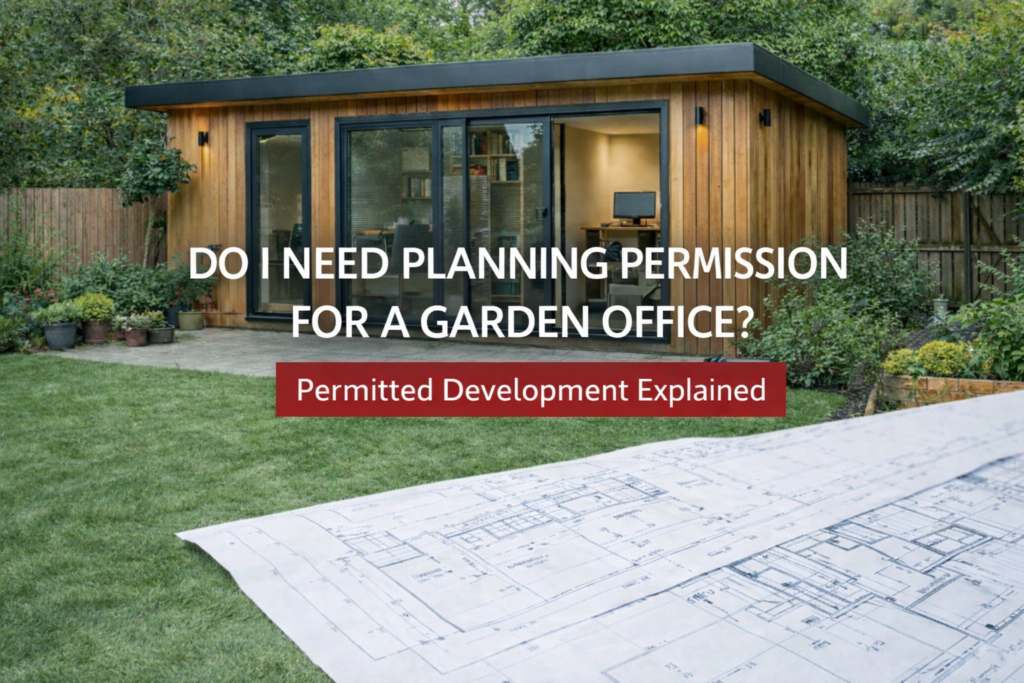
Since the Covid-19 pandemic, demand for garden offices has risen sharply as more people work from home. In many cases, a garden office is classed as an outbuilding and can fall within permitted development. However, the rules are not the same for every property, so the answer is rarely a simple yes or no. In most cases, the correct answer is “it depends.”
How Does the Type of Property Affect Permitted Development Rights?
Permitted development rights vary depending on property type, location, and the scale and position of the proposed garden office.
Houses
If you live in a typical single dwelling house, your garden office is likely to be permitted development, provided it meets the relevant size and siting rules, which we cover later in this article.
Flats and Maisonettes
If you live in a flat or maisonette, permitted development rights do not apply at all. This includes ground floor flats with private gardens. As flats are not considered sole ownership of the land, any garden office will require full planning permission.
Listed Buildings
If your property is listed (Grade I or Grade II), permitted development rights are automatically removed. Any external works – including a garden office – will require planning permission and listed building consent.
Planning applications for listed buildings often require a sensitive approach and a strong understanding of heritage legislation. The process can also take longer due to additional consultation requirements.
Planning Permission and Article 4 Directions
Even if your property is not a flat or listed building, permitted development rights can still be restricted by an Article 4 Direction.
An Article 4 Direction removes specific permitted development rights from a property, usually to prevent overdevelopment in sensitive areas. You can check whether your property is affected by:
- Your property deeds, or
- Contacting your local planning authority
The good news is that most homes are not affected by Article 4 Directions and retain full permitted development rights.
How Does Location Affect Garden Office Planning Rules?
Your location plays a key role in determining whether planning permission is required.
If your property is located within:
- A Conservation Area
- An Area of Outstanding Natural Beauty (AONB)
- A National Park
…then planning permission is usually required, regardless of the size or position of the garden office.
If you live within an AONB or National Park, additional restrictions apply. In many cases, any outbuilding located more than 20 metres from the house is limited to a maximum floor area of 10 square metres, which can significantly restrict design options.
Does the Size and Position of a Garden Office Matter?
Yes – size and position are critical factors in determining whether a garden office falls within permitted development.
Building in Front of the House
If a garden office is proposed in front of the principal elevation (the main front of the house), planning permission will always be required.
This is particularly relevant where homeowners want separate access for clients or suppliers, or wish to keep their rear garden as a private space. If your property only has a front garden, planning permission will be unavoidable.
Maximum Land Coverage
Under permitted development, all outbuildings must not cover more than 50% of the total land surrounding the original house.
This includes:
- Existing extensions
- Sheds
- Garages
- Other outbuildings
This restriction is designed to prevent overdevelopment and can be a limiting factor for properties with smaller gardens or those that have already been extended – such as many Victorian townhouses.
Height Restrictions for Garden Offices
To qualify as permitted development, a garden office must:
- Be single-storey
- Have a maximum eaves height of 2.5m
- Have a maximum overall height of:
- 4m for dual-pitched roofs
- 3m for flat or mono-pitch roofs
If the building is within 2 metres of a boundary, the entire structure (including the roof) must not exceed 2.5m in height.
These rules exist to minimise impact on neighbouring properties and protect light and outlook.
Balconies, Verandas and Raised Platforms
Permitted development rights place strict limits on raised features.
Balconies, verandas or raised platforms are only permitted if they are no more than 300mm above finished ground level. Anything higher will require planning permission.
A Final but Important Limitation: Use of the Building
To qualify as permitted development, a garden office must not be used as self-contained living accommodation.
This means:
- No sleeping accommodation
- No independent dwelling use
- No use as an Airbnb or holiday let
Any outbuilding intended for residential use will require planning permission.
Internet and Antennas
Another lesser-known restriction is that outbuildings built under permitted development must not include a microwave antenna.
Microwave antennas are used for certain types of digital communication, including some broadband systems. If your garden office cannot achieve adequate internet access without installing one, you may need to apply for planning permission.
Professional Advice Makes the Difference
While many garden offices fall within permitted development, small changes in location, size or use can trigger the need for planning permission.
If you are unsure whether your proposal complies, taking professional advice early can save time, cost and stress later in the process.
Found this useful? Share it with someone planning a project.
Unsure if Your Garden Office Needs Planning Permission?
Permitted development rules can be complex, and small details can make a big difference. If you are considering a garden office and want clear, professional advice on whether planning permission is required, RGS Architectural Design Consultants can help.
We regularly advise homeowners across Devon and the South West on permitted development, planning applications and compliant garden office designs.